


The Colors of Balinese Painting
In the context of Balinese traditional visual culture, white is recognized as one of the three fundamental colors, together with red and black.
Almost every day, we encounter white walls in our rooms or homes. And every day, a question quietly emerges: can the white on these walls truly be considered a color? If your answer is yes, then behind every white wall lies a world of hidden meanings.
The same applies to painting. White is an essential color used to establish mood, atmosphere, and artistic intent. Its significance is reflected in the many names given to tubes of white paint, including zinc white, pure white, titanium white, and iridescent white.
Within the context of Balinese traditional visual culture, white is recognized as one of the three primary colors, alongside red and black. Together, these three colors represent a symbolic system that carries philosophical, cosmological, and ritual meanings across various local materials and practices in Bali. This concept extends beyond the aesthetic qualities of color alone; it is deeply connected to the worldview of Balinese society, particularly within the framework of Tri Hita Karana and Balinese Hindu cosmology.
The many stories behind color are thoughtfully presented in the book titled Warna Bali. Published by Penerbit Buku Kompas in 2026, the book is available in two editions: an Indonesian edition with a white cover and an English edition with a green cover.
A central focus of the book is the historical connection between Balinese culture and the civilizations of China and India. One of the key discussions is an in-depth study of the color red, written by Savitri Sastrawan.
Using zhu sha or gincu (vermilion) as a case study—a color that has become widely recognized in Balinese tradition—the essay explores the origins and significance of this pigment. Gincu, now commonly associated with lipstick, is derived from the deep red mineral known as cinnabar or mercury sulphide. According to Edward H. Schafer’s article “The Early History of Lead Pigments and Cosmetics in China” (1956), the extraction and oxidation processes of such materials are believed to have existed in China as early as 3,000 BCE. This provides evidence that cultural connections, exchanges, and influences have long been important aspects of historical discourse.
The five authors of this 274-page book each examine the interconnected relationships between Bali and external cultures—such as China, India, and Southeast Asia—as reflected through the symbolism of color. Author Seriyogaparta, for example, explores the Ramayana wayang paintings of Tigawasa Village as part of the broader history of maritime trade networks across the Indonesian archipelago and Asia.
The cultural narratives embedded within the use and creative processes of color in Kamasan-style paintings are presented in the final section of the book by Made Susanta Dwitanaya. Through a collection of essays, the book concludes that although Balinese colors have been influenced by external cultures, their identity continues to embody two essential dimensions: the symbolic and the magical.
In general, this book, rooted in art history and aesthetics, offers an example for other regions seeking to trace the origins of local cultural heritage in Indonesia. By understanding history, ways of thinking, pigment-making techniques, and the aesthetics of color, readers are invited to recognize that cultural assets such as Balinese colors do not emerge in isolation. They are shaped by intercultural influences, as well as by relationships between human beings, nature, and the divine.
However, conceptually, the book remains primarily focused on an internal framework—more specifically, positioning color as an inherent element within Bali’s own cultural cosmology. The editor’s introduction, which emphasizes that color emerges from cosmic emptiness and is centered around a structure of four directions with a central point, indicates that the discussion is largely focused on an endogenous symbolic structure. In this context, color is positioned as part of a local knowledge system that remains relatively self-contained and autonomous.
While this approach is important as a foundation, it also somewhat limits the reader’s broader imagination. By remaining within a micro-perspective—centered on cosmology, symbolism, and internal cultural structures—the book has yet to fully connect color with external dynamics, such as historical transformations, encounters between civilizations, and global circulation within contemporary art and culture.
In today’s context, color functions not only as a symbolic system but also as part of cultural practices intertwined with the creative economy, tourism industry, identity discourse, and even global politics and business. Concepts such as Nawa Sanga and Tridatu, discussed in the book, can be revisited not only as local cosmological frameworks but also as forms of visual knowledge capable of engaging with contemporary artistic practices and global cultural markets.
Therefore, future development should expand the analytical framework from a symbolic approach toward a more contextual and interdisciplinary perspective. This includes examining color through its relationship with material history, cultural mobility, and the global visual economy. In this way, Balinese color should not be understood as a static cultural inheritance, but rather as a dynamic field that continues to be created, negotiated, and represented across various contexts.
In contemporary times, color is not merely a symbolic system; it is also part of cultural practices intertwined with the creative economy, tourism industry, identity discourse, and even global politics.
Ultimately, the white cover of this book invites us to look deeper into the meaning and existence of Balinese colors—as deeply and as broadly as possible.
Mikke Susanto
Curator and Lecturer at the Indonesian Institute of the Arts Yogyakarta (ISI Yogyakarta)
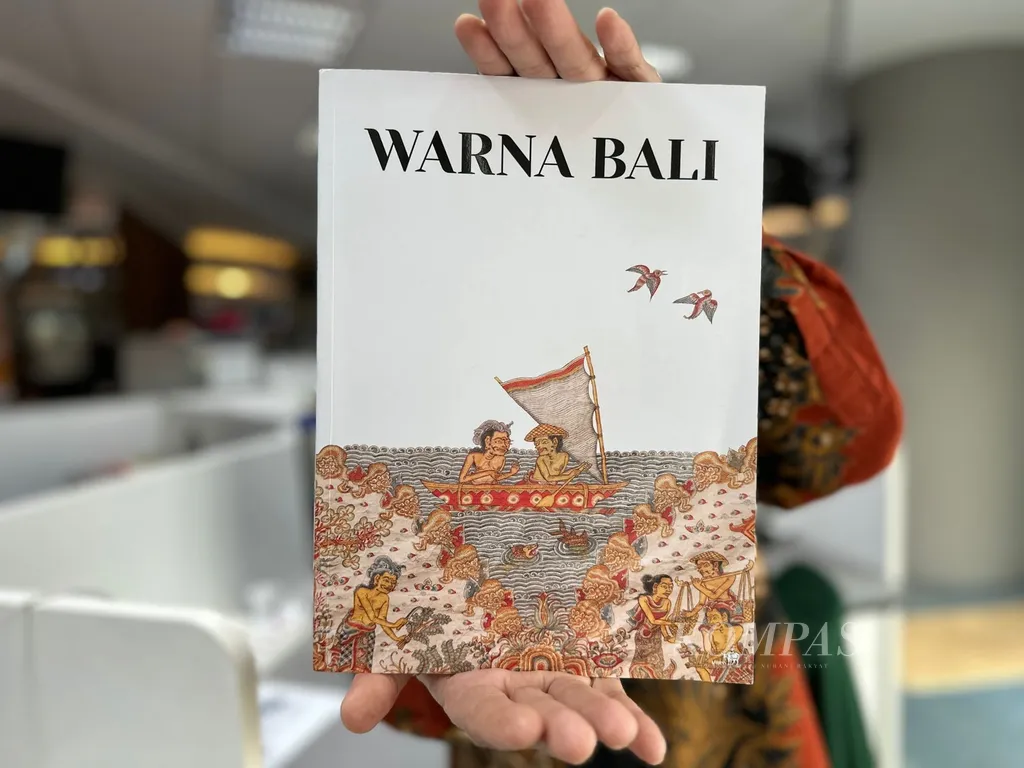
The Colors of Bali
Authors:
– I Wayan Seriyoga Parta
– I Made Susanta Dwitanaya
– Dewa Gede Purwita
– Dewa Ayu Eka Savitri Sastrawan
– I Gede Gita Purnama Arsa Putra
Language Editor: Putu Fajar Arcana
Pages: vi+274 pages (280 pages total)
Dimensions: 20 cm x 27 cm
Published: 2026
Publisher: Penerbit Buku Kompas